It’s been a while. I was inspired by last week’s visit to the Czech Republic and Austria to share a story co-authored with my friend and former colleague Shiloh Turner. A Fulbright Scholar, she is teaching philanthropy at Masaryk University in Brno. This is our shared story of a fun, cultural visit that included two wine regions new to me.
Cities, Conversations, and the Classroom
| Moravia |
This week’s entry takes a slightly different form. Kathy—my next visitor and a guest lecturer in my classroom—joined me for a multi-city stretch, and throughout this entry, you’ll hear directly from her as well.
We began in Prague, where I introduced a mix of returning favorites and a few new discoveries that quickly earned their place.
The standbys still hold:
• Dinner at Terasa U Prince overlooking Old Town Square and the Astronomical Clock—one of those views that never quite loses its impact.
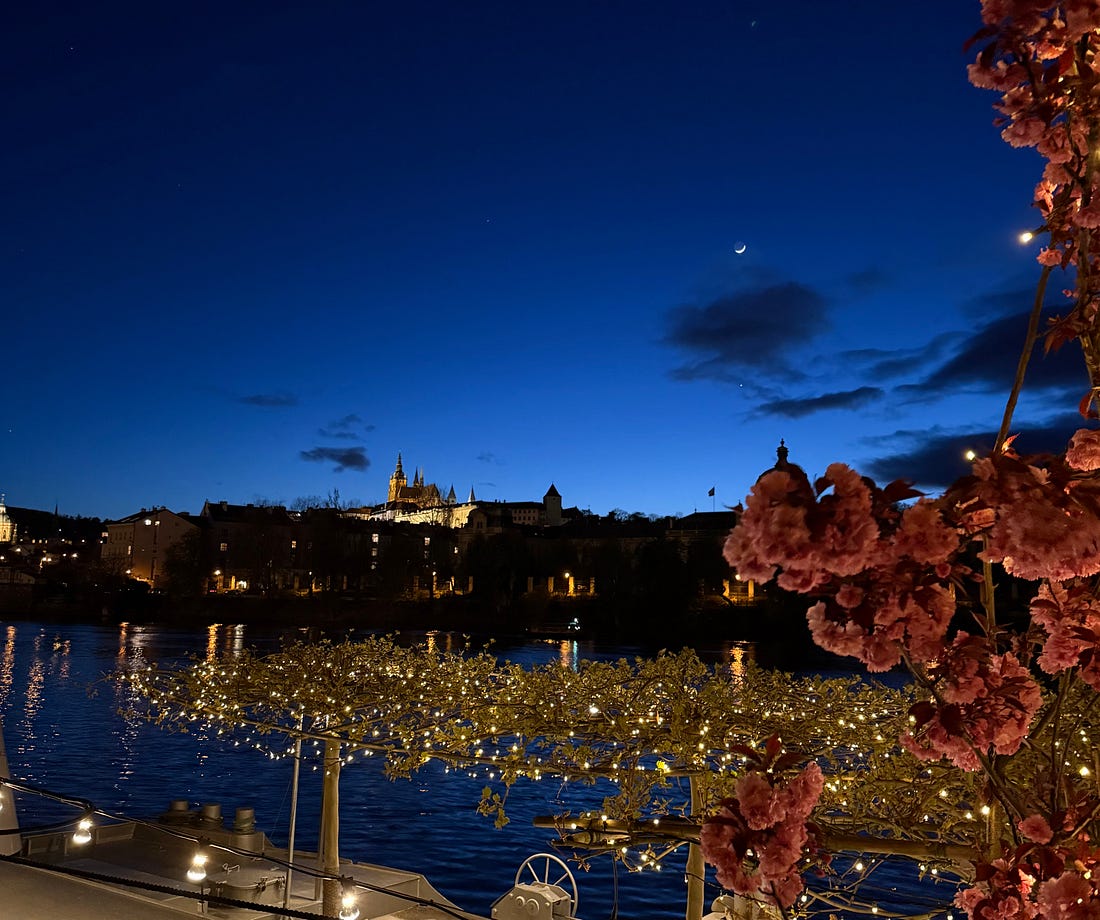
• An evening cruise on the Vltava River—Prague at night, lit from the water, remains one of the most beautiful scenes I’ve experienced anywhere.
• A full walk through Prague Castle—still astonishing in both scale and presence (and yes, officially the largest castle complex in the world).
• And my personal favorite café in the city: Cafe Grand Orient—equal parts design statement and reliably excellent breakfast.
But it was the new additions that made this visit feel fresh again.
Just outside our apartment sat Havelské tržiště, an open-air market dating back to 1232 under King Wenceslas (yes, that Wenceslas). Fresh fruit and spa wafers quickly became our unofficial Czech breakfast of champions.
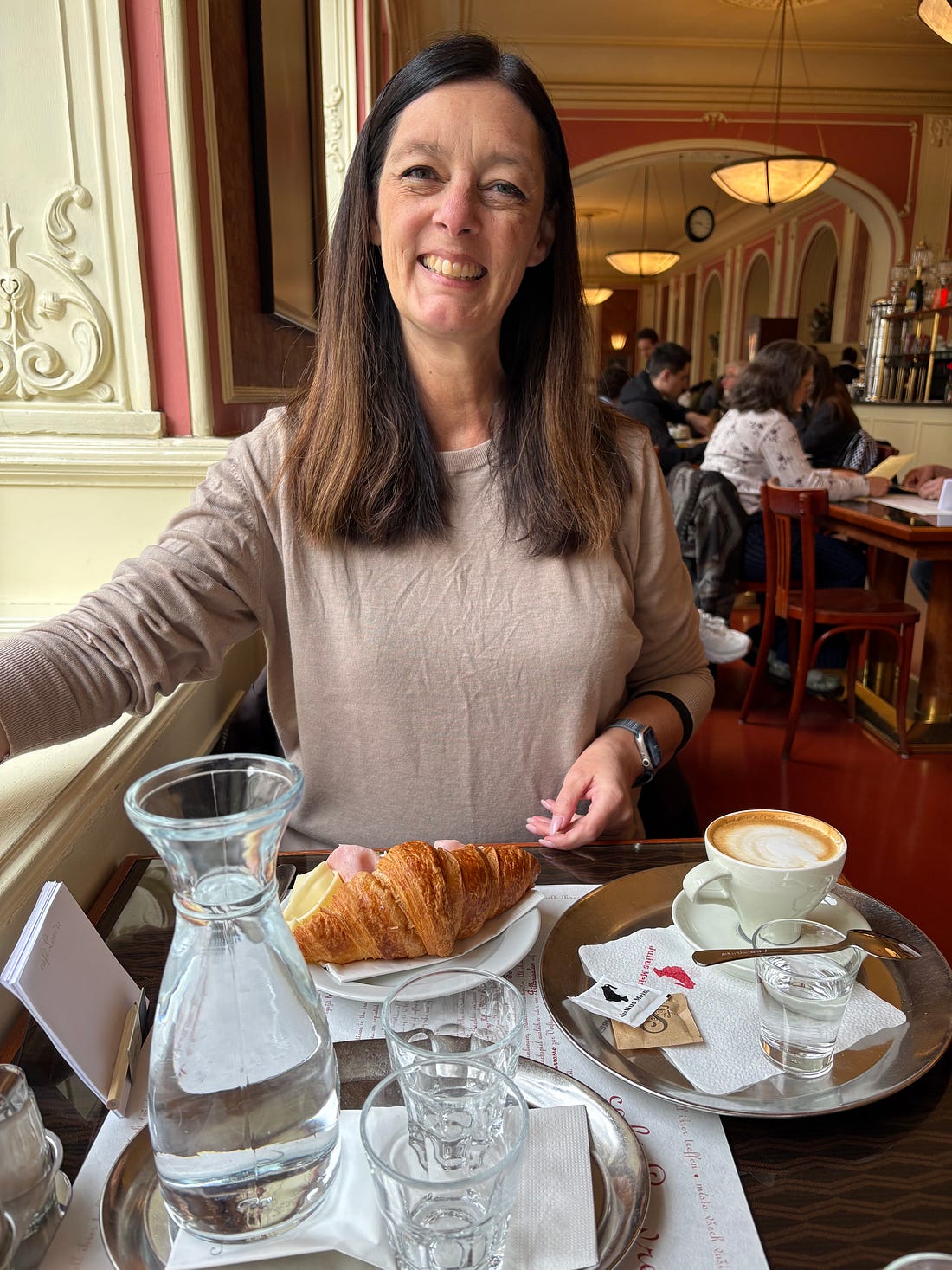
We also stopped at Cafe Louvre—once frequented by Albert Einstein during his time in Prague—where the cappuccino and ham-and-cheese croissant fully lived up to the history.
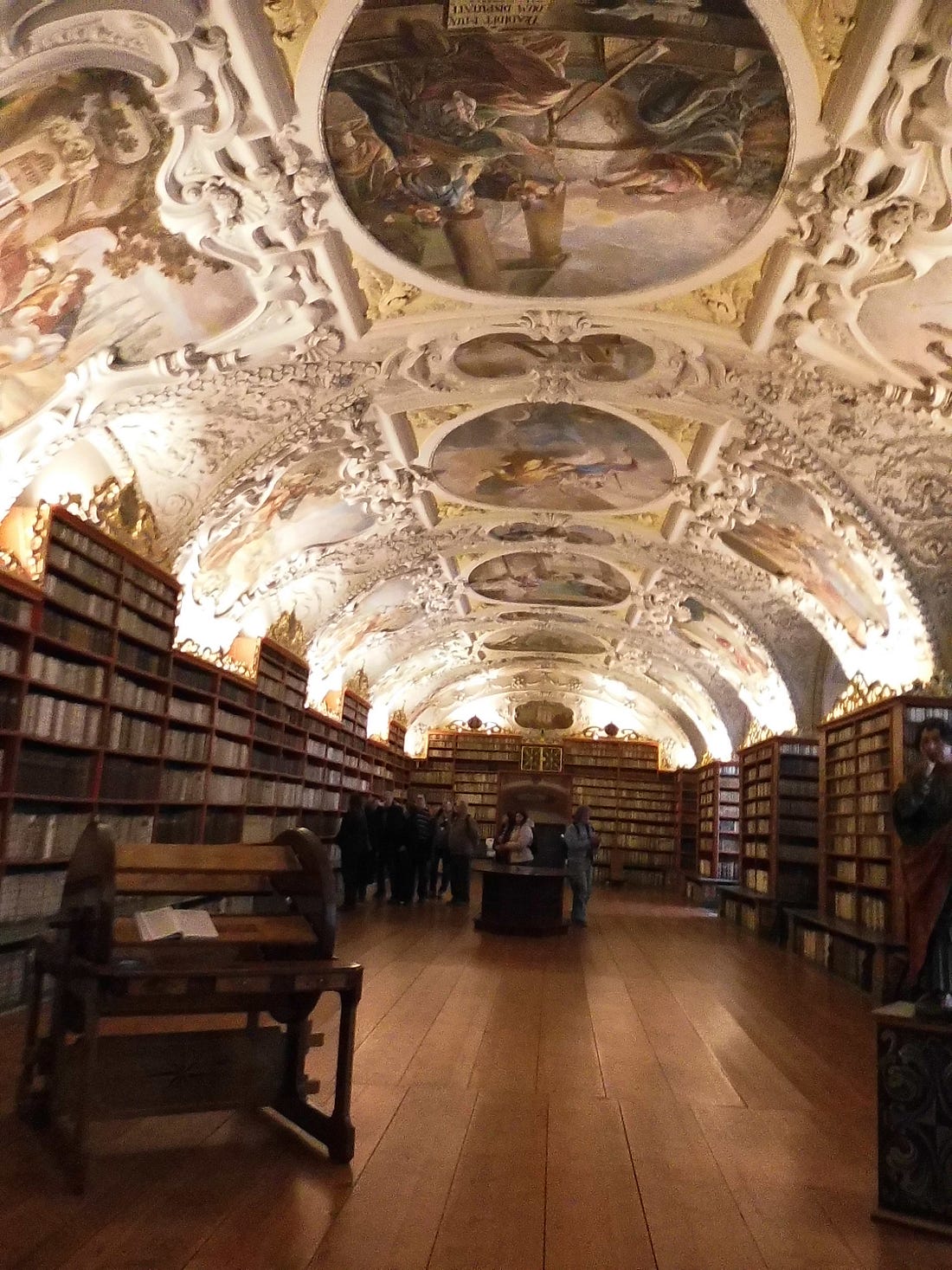
And finally, the quiet grandeur of Strahov Monastery Library—one of those spaces that commands a kind of quiet attention.
We closed out Prague with dinner at Mlýnec, a Michelin-recommended restaurant at the foot of the Charles Bridge—part of a pair of Michelin meals that framed the week.
Kathy’s perspective: Prague, then and now
Prague sparkles. Literally. I visited Prague more than 30 years ago, in the early 1990s, as the grip of communism was beginning to loosen. Of course, the highlights of Old Town, Prague Castle, and the Charles Bridge haven’t changed. But everything else was so different. I remember the buildings being covered in black soot, some from wartime effects, some because of lack of funds to do cleaning and conservation. That all began to change 30+ years ago when the “Velvet Divorce” separating the Czech Republic from Slovakia was finalized in 1992, arts and culture began to blossom, and privatization fueled by capital from outside investors developed today’s beautiful city (and suburbs). The Czech Republic joined the European Union in 2004, bringing even more investment and development to Bohemia. Prague is bright, clean, and sparkling with vibrant energy.
Kathy on Czech gemstones
Of equal, if not greater, interest to me were the region’s sparkling precious gems: garnets (red) and moldavite (green). While garnets are mined around the world, the garnets from Bohemia have a unique, rich red color often called “pigeon blood.” They are a particular variety of pyrope garnet. 99% of Moldavite comes from South Bohemia. It is an artifact created by the impact of a 15-million-year-old meteorite that scattered bits across a wide area. It purportedly has mystical powers and cosmic energy. Spoiler alert: I’m not feeling it… But it is a gorgeous stone and I’m thrilled to own one. My mission to acquire a few of these precious items was delightfully fulfilled. For Prague shoppers: visit Granat Turnov and Cohen Jewelers.
From there, we headed back to Brno—where Kathy stepped into the classroom.
She delivered a guest lecture on strategic philanthropy that landed exactly as you would hope: inspirational, candid, and clear about what it actually takes to create lasting impact.
Students came prepared, asked thoughtful questions, and—most noticeably—demonstrated how much their understanding of the field has evolved over the semester.
She brought a practitioner’s perspective that complemented the course—adding depth, specificity, and real-world insight in ways only experience allows.
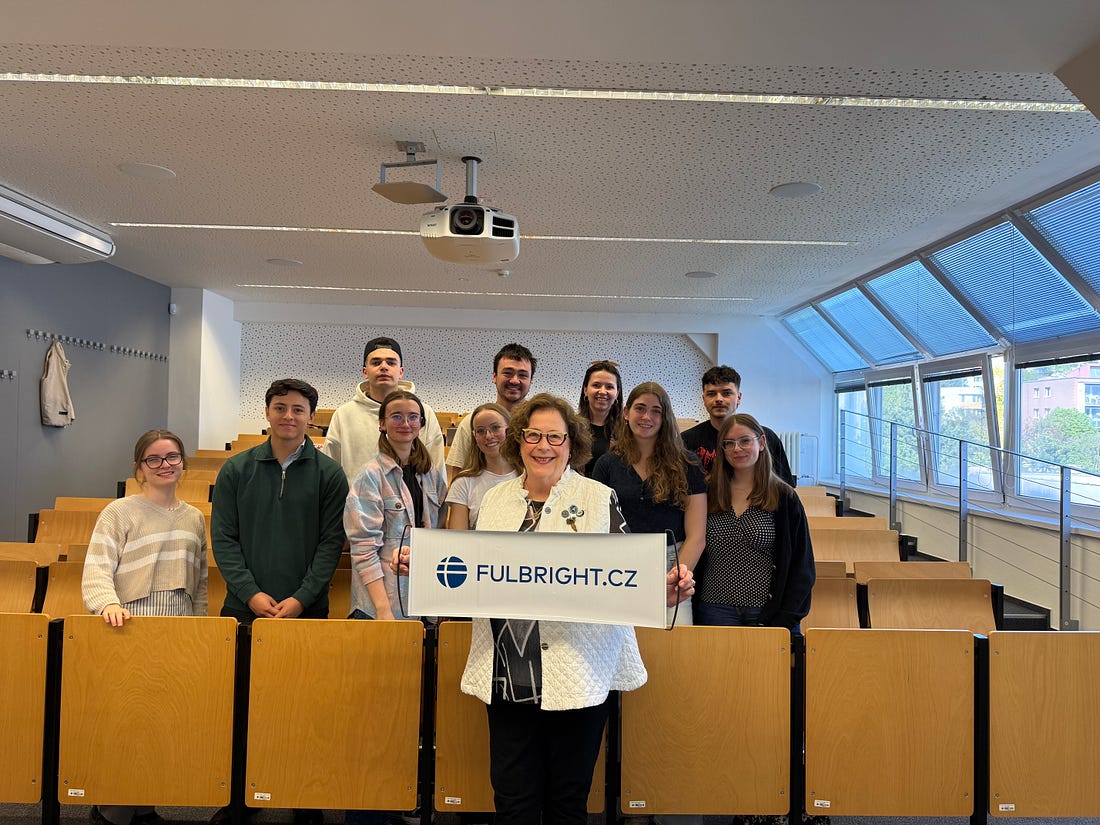
Kathy in the classroom
Shiloh and I agreed in advance that I would divide my time with her students in three parts. First was a quick dance across the highlights of my career, starting with my love of writing and journalism as a teenager, ending with my current “post-retirement” work as a nonfiction author of soon-to-be six books. In the middle of those bookends I traced my journey from choosing the social work profession (planning and administration) and pulling that thread through career stops that included grantmaking and community development focus areas.
The second part laced my professional relationship with Shiloh through a period of more than 25 years, sharing how the two of us—in both partner organizations and jointly at a community foundation—paved the way for new approaches to strategic philanthropy. (The budget recap of topics included nonprofit-to-profit conversion endowments (foundations), collective impact, and impact investing.)
Last, but not least was a quick window into my wine-related education and experience, my joyful window into the world, always a fun thing to end with when discussing important matters of strategic philanthropy! The students were interested in the conversation, and interesting both during and after the class, but my favorite part of the experience was being able to see Shiloh in her Fulbright element as an approachable, confident professor. Her curriculum is outstanding!
That evening, I invited my faculty host Vladimir and fellow Fulbright Scholar Marci to join us for dinner—one of those moments where different parts of my life intersected in a really meaningful way.
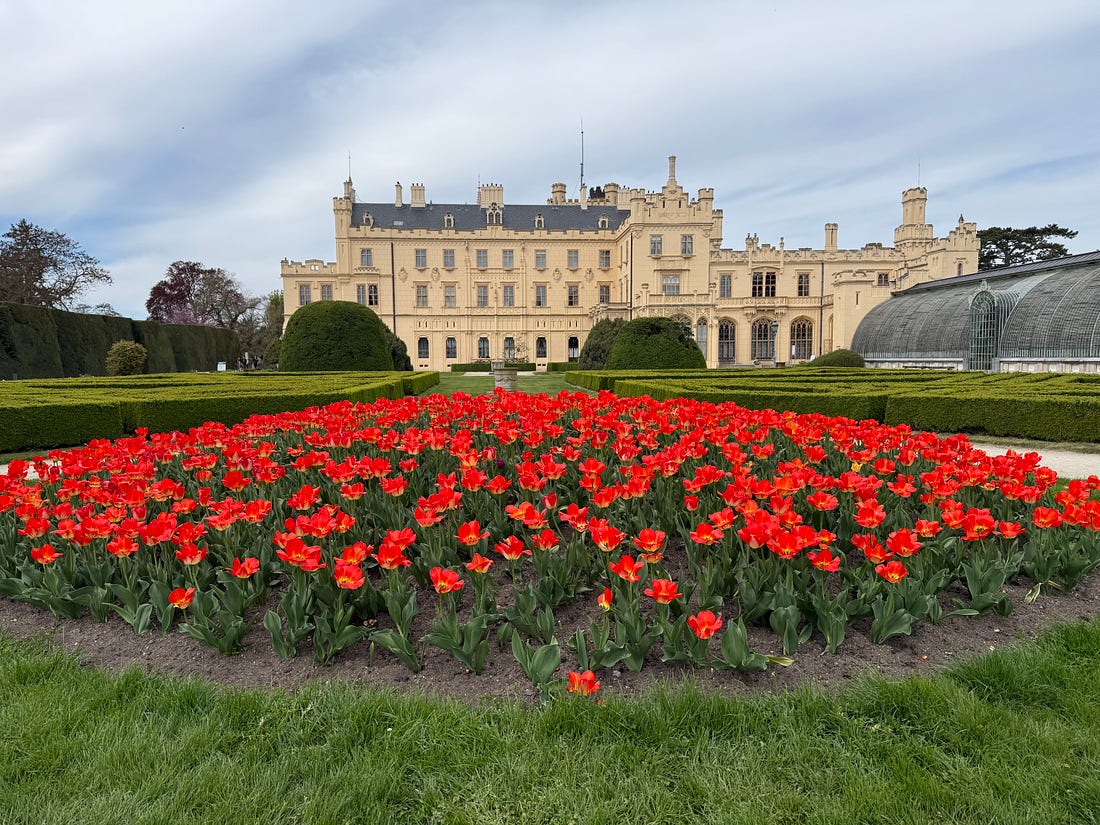
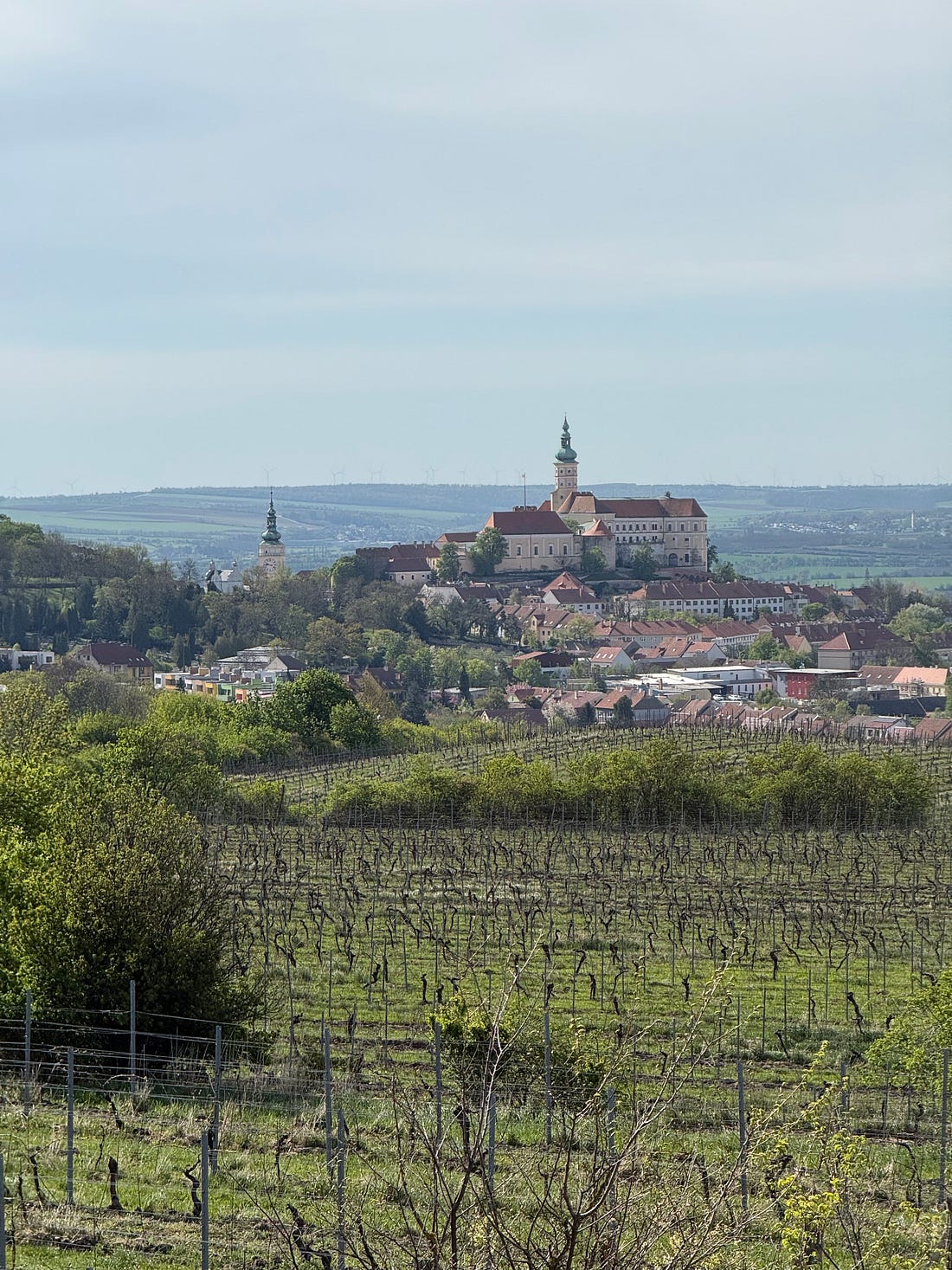
Thursday gave us a picture-perfect spring day to explore Moravia—the eastern region of the Czech Republic and home of Brno.
Our focus was the Lednice–Valtice Cultural Landscape, one of the country’s UNESCO World Heritage Sites.
We began just outside Mikulov, taking in the landscape from above—an immediate sense of the scale and character that define this region.
From there, we moved into the Lednice–Valtice area itself, shaped over centuries by the Liechtenstein family. The integration of architecture, land, and long-term planning is striking—an expansive, deliberate vision of stewardship that still holds today.
We spent the afternoon moving through the region, approaching it through Kathy’s study of wine and a shared sense of discovery—she’ll pick up that part of the story.
Kathy on Moravian wine country
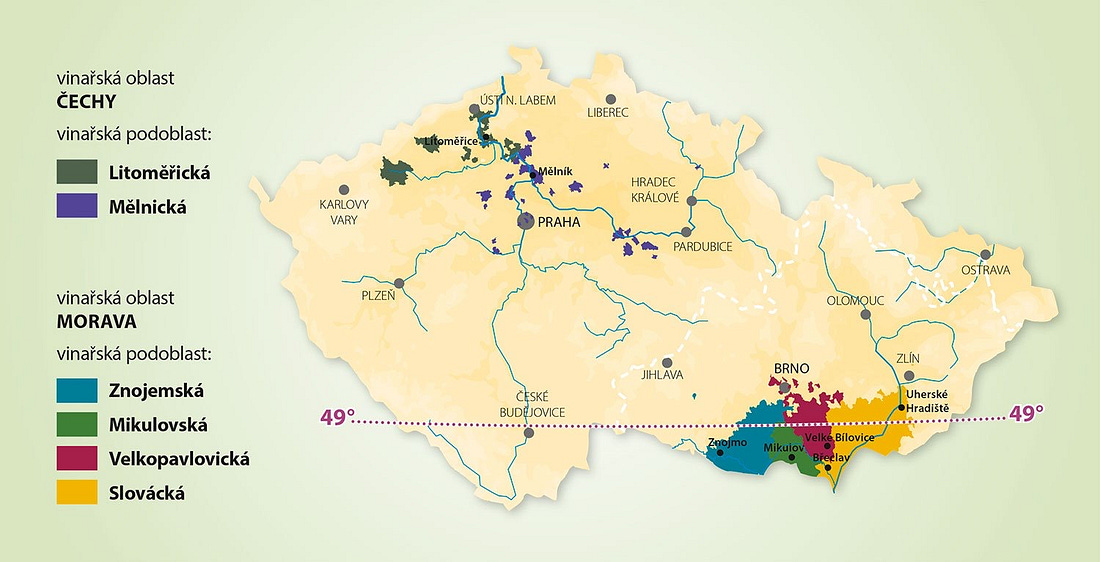
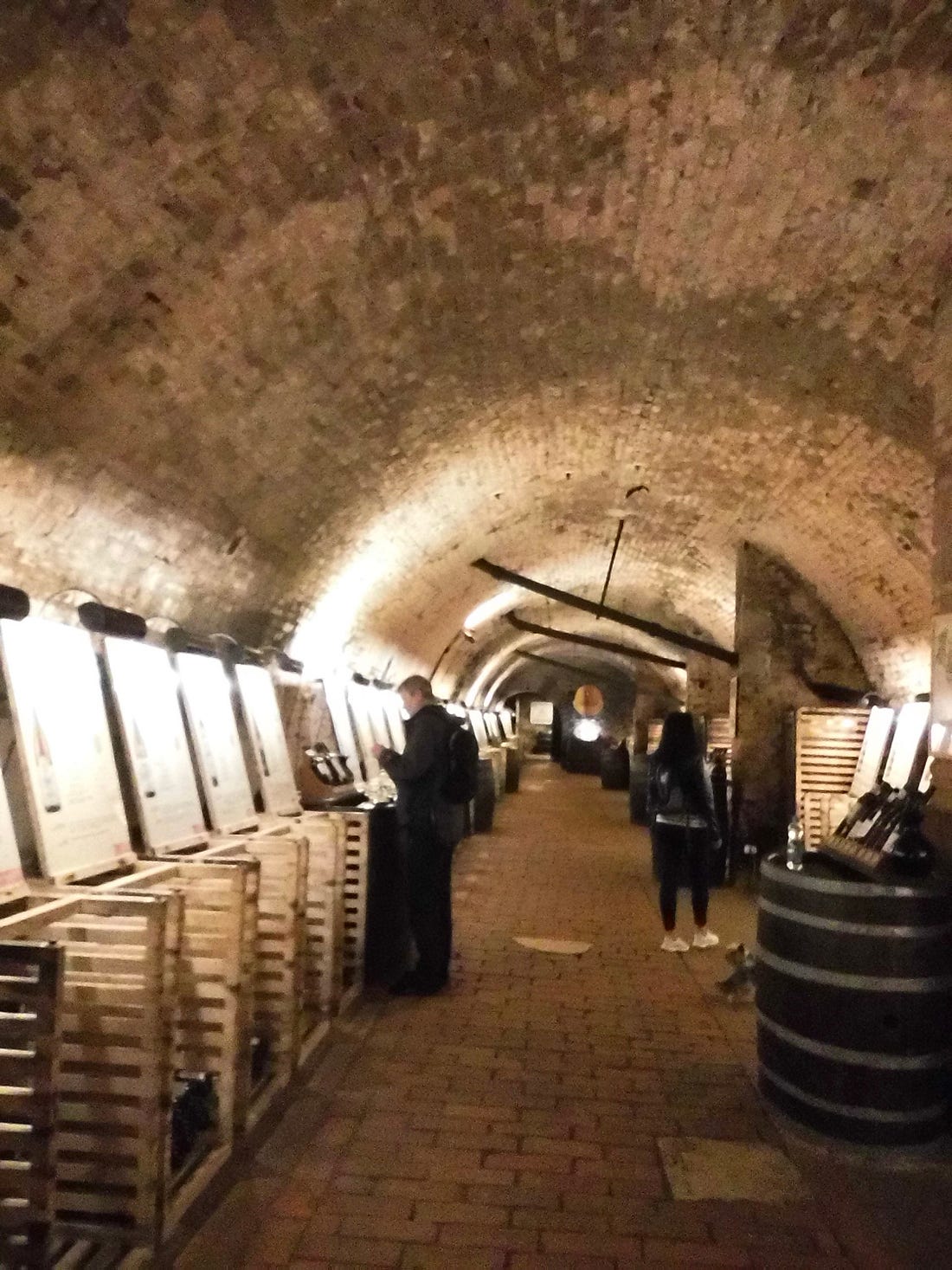
Our guide, Max, gave us an amazing tutorial on the history and culture of the region as we visited Mikulov, Lednice, and Valtice. Having already revealed my joy in learning about wine, I was pleasantly surprised at the depth of Max’s knowledge about all things viticulture and viniculture, from the composition of the limestone soil to the local grape varieties to the winemaking process. Moravia produces 94% of all wine from the Czech Republic, mostly white, mostly Grüner Veltliner and Riesling (both now considered international grapes) along with an indigenous grape called Pálava that offers spicy, floral notes. The region’s continental climate along the 49th parallel puts Moravia in good growing company with Champagne and Alsace for cool-climate, low-alcohol wines. Of particular note for me was “The Wine Salon,” a permanent tasting exhibition of the 100 best wines awarded annually in the Czech Republic. The (literally) coolest part is that the Salon is located in the Valtice Chateau!
Friday took us to Vienna for the final leg.
We started with an early dinner at Café Sacher Wien—because when in Vienna, you order the Sacher Torte.
Then on to the Vienna State Opera for Simon Boccanegra. The building was stunning. The talent was undeniable. The seats…less so. A lean-forward-or-miss-it situation, paired with unusually minimalist staging, led us to make an early exit at intermission. We’re assuming the main character dies in the end. That feels like a safe bet.
Saturday delivered one of those rare, perfectly balanced days.
We began at Belvedere Palace, home to Gustav Klimt’s The Kiss. And thanks to an early entry time, we were able to experience it without the usual crowds. It’s one of those works that quietly holds your attention longer than you expect.
From there—and after a bit of tram and train station confusion (we confidently headed to Wien Hauptbahnhof…only to realize we were actually departing from Wien Westbahnhof)—we made a last-minute scramble across the city. In the end, we just made the train, with me planted in the doorway holding it open while Kathy did her best sprint-with-a-bad-back down the platform. Not our most graceful moment, but we made it!
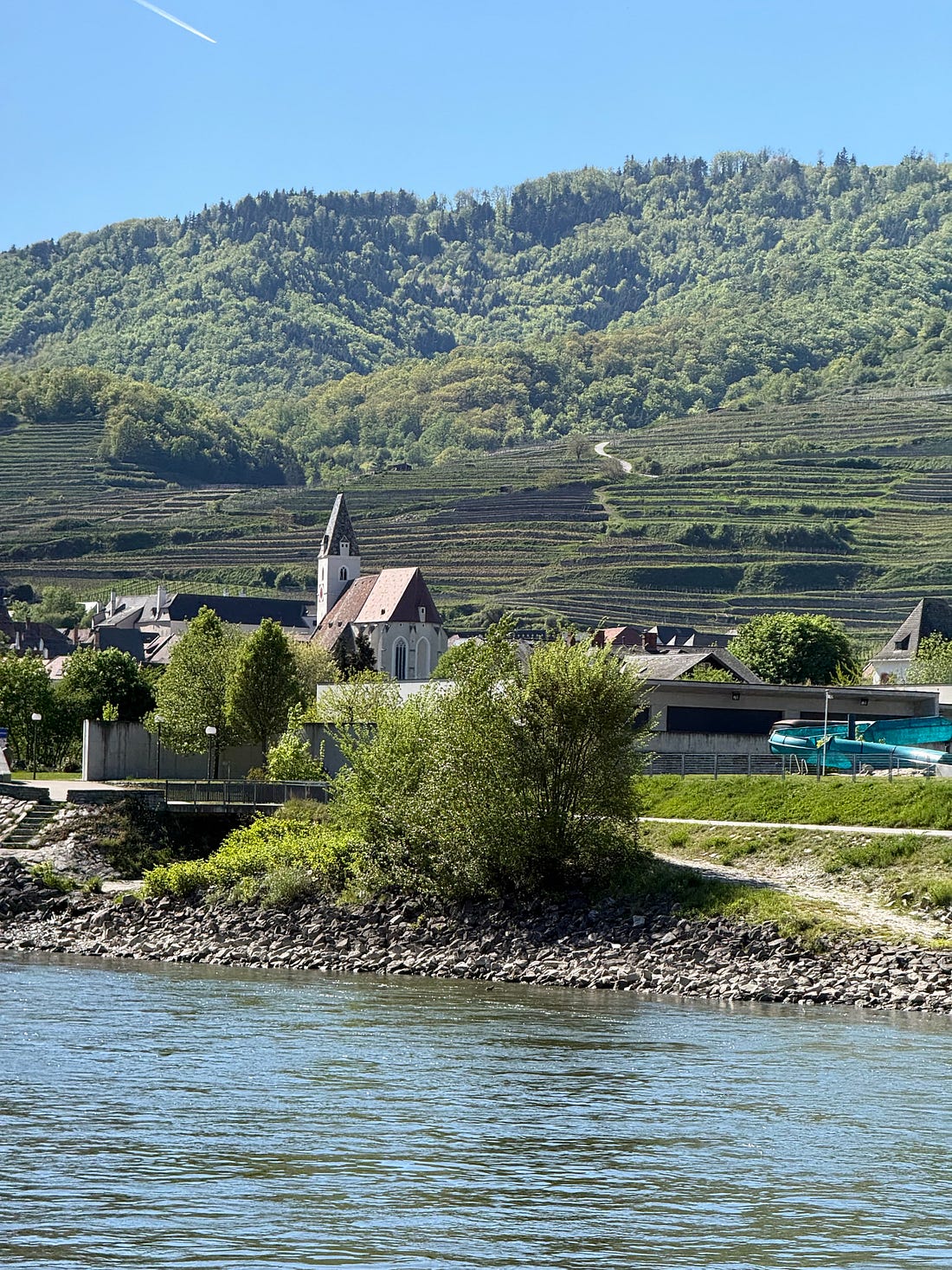
From there, we were on our way to Melk for a Danube cruise through the Wachau Valley, ending in Krems. Rolling hills, terraced vineyards, and small villages—it’s exactly the landscape you hope for.
Kathy on the Danube
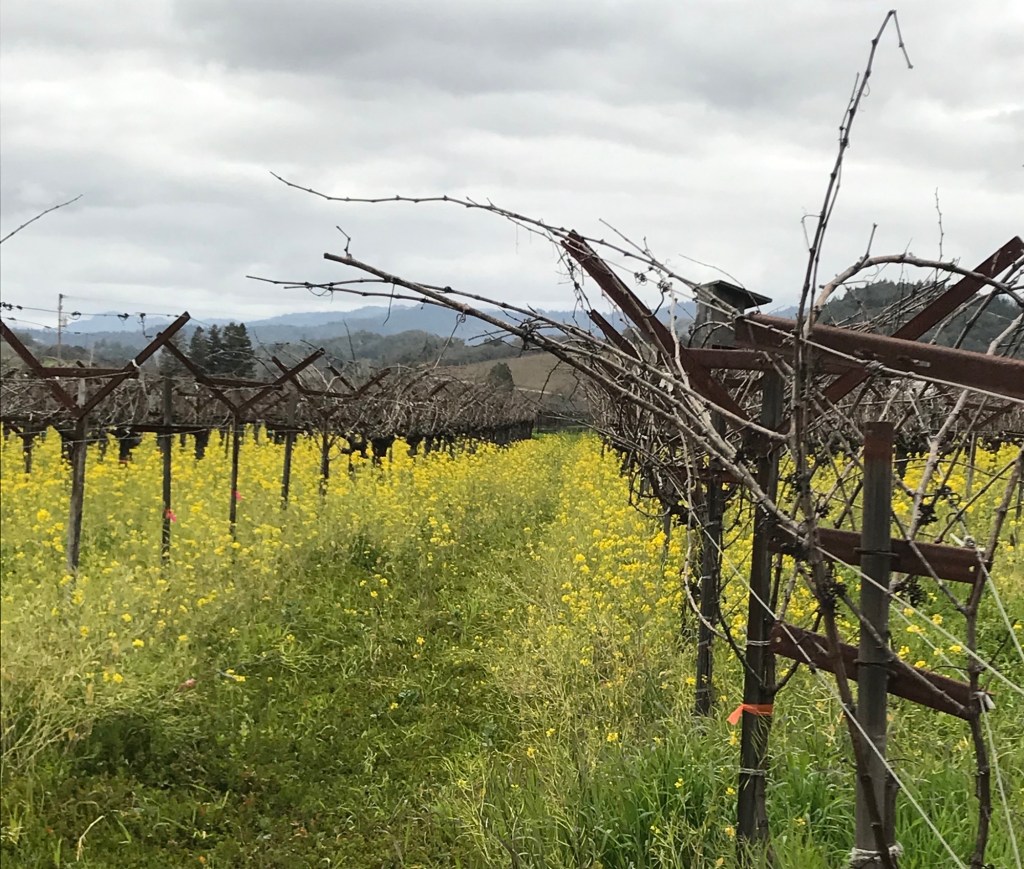
This might be hard to explain, so hopefully a picture is worth many words, but I felt an overwhelming sense of peace with the rhythms of the world on our journey along the Danube through the Wachau wine region. The steep hillsides sloped down to little towns dotting the shoreline, and in some cases swooped right down to the river’s edge. Spring, and budbreak on the vines, was in full swing—lush, inviting, magical. Steep terracing defies logic, for planting, for harvesting. I visited Portugal last year and felt the same way as I traveled along the Douro River. I am grateful for this pair of experiences, and for the gorgeous sunny day and soft spring air that ushered us gently along from Melk to Krems.
Sunday—our final day—started at Schönbrunn Palace.
The scale rivals Versailles. Unfortunately, so do the crowds.
We caught one of the last days of the Easter market, where we managed both a bit of shopping and an excellent apple strudel with vanilla cream sauce—well worth navigating the crowds.
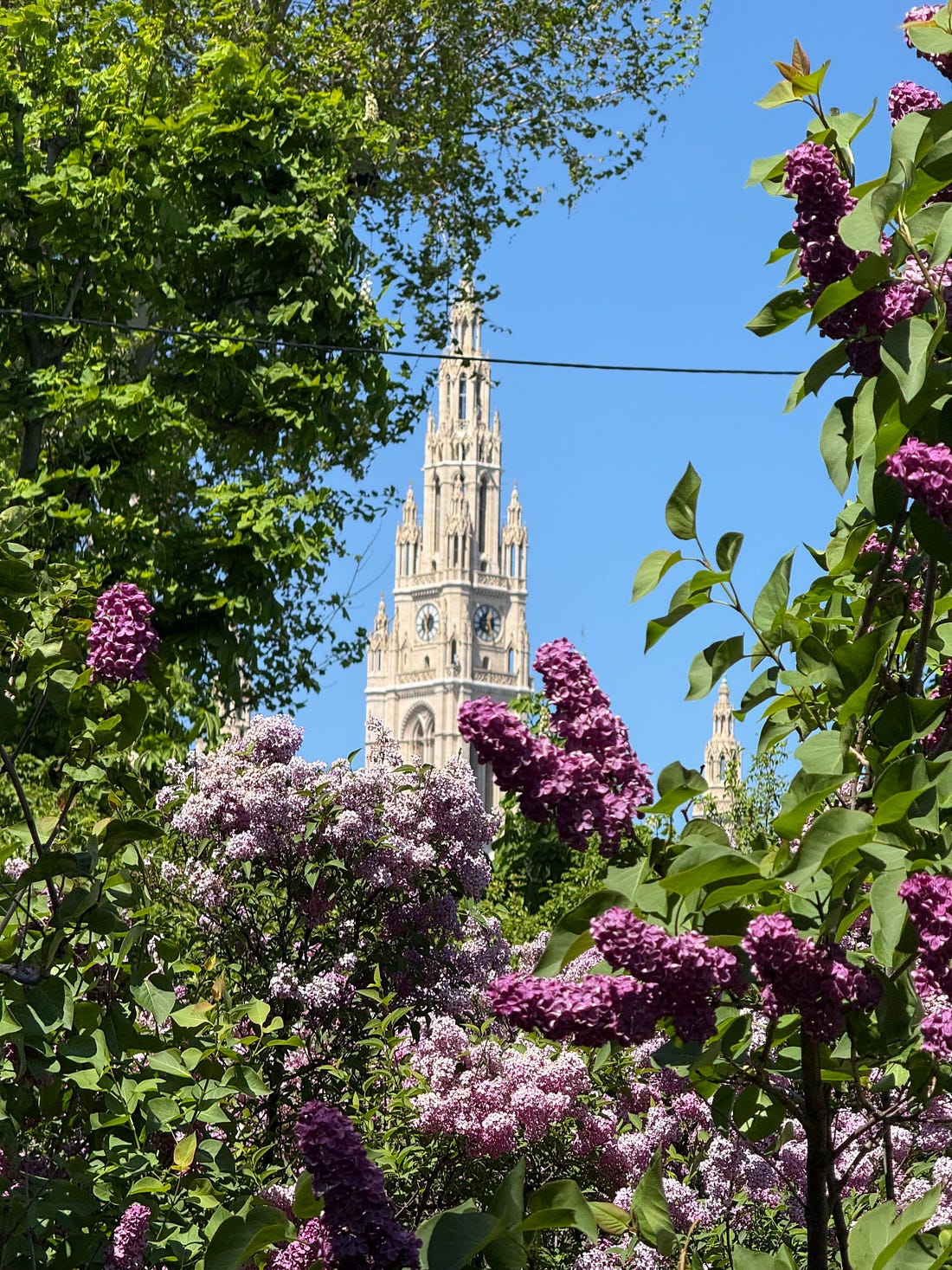
To cover more ground (and save our feet), we opted for an open-air car tour through the city center, passing landmarks like the Hofburg Palace, Volksgarten, and City Hall—which, in Vienna fashion, looks more like a palace than a government building.
Vienna delivers exactly what you expect—cafes, palaces, gardens—layered into a city that feels both historic and highly cosmopolitan.
We both agreed we could live there…if not for some of the people.
They can be distinctly brusque—at times bordering on unfriendly. Enough to make the Czechs feel warm by comparison.
We closed out the visit with dinner at Do & Co, overlooking St. Stephen’s Cathedral—a fitting complement to our final night in Prague, with both cities ending on memorable meals at Michelin-listed restaurants.
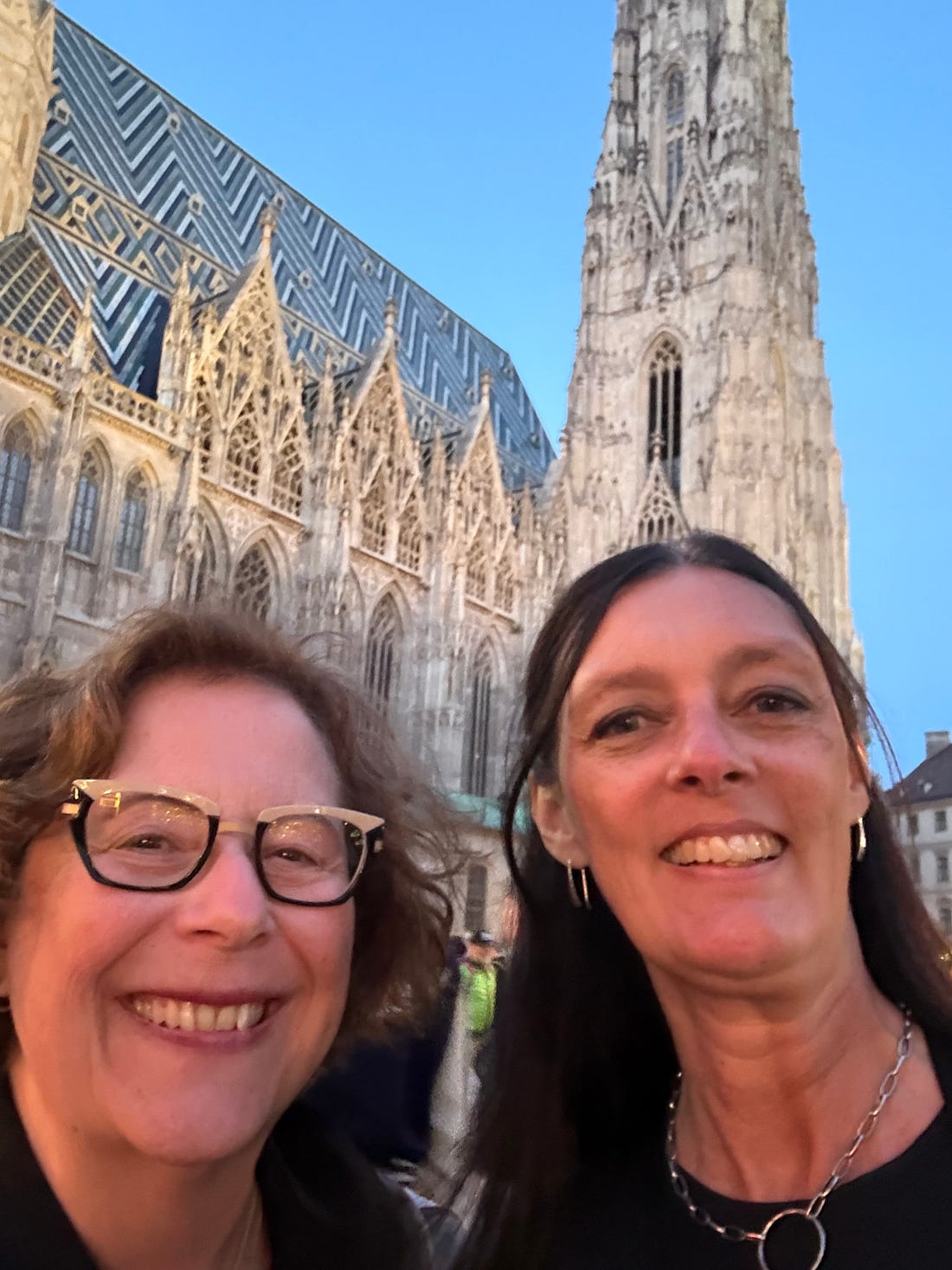
In between the cities and the classroom, our conversations—about our work, our lives, and the paths that shaped them—brought a deeper understanding and appreciation, and I’m grateful for the time and perspective we shared.
Kathy is now on to Bordeaux, and I’m heading back to Brno for a full week of teaching across three classrooms.
Another reminder—one that seems to be coming more frequently these days—that this chapter of life is a good one.




 Vino Ventures
Leave a reply to Shiloh Cancel reply